
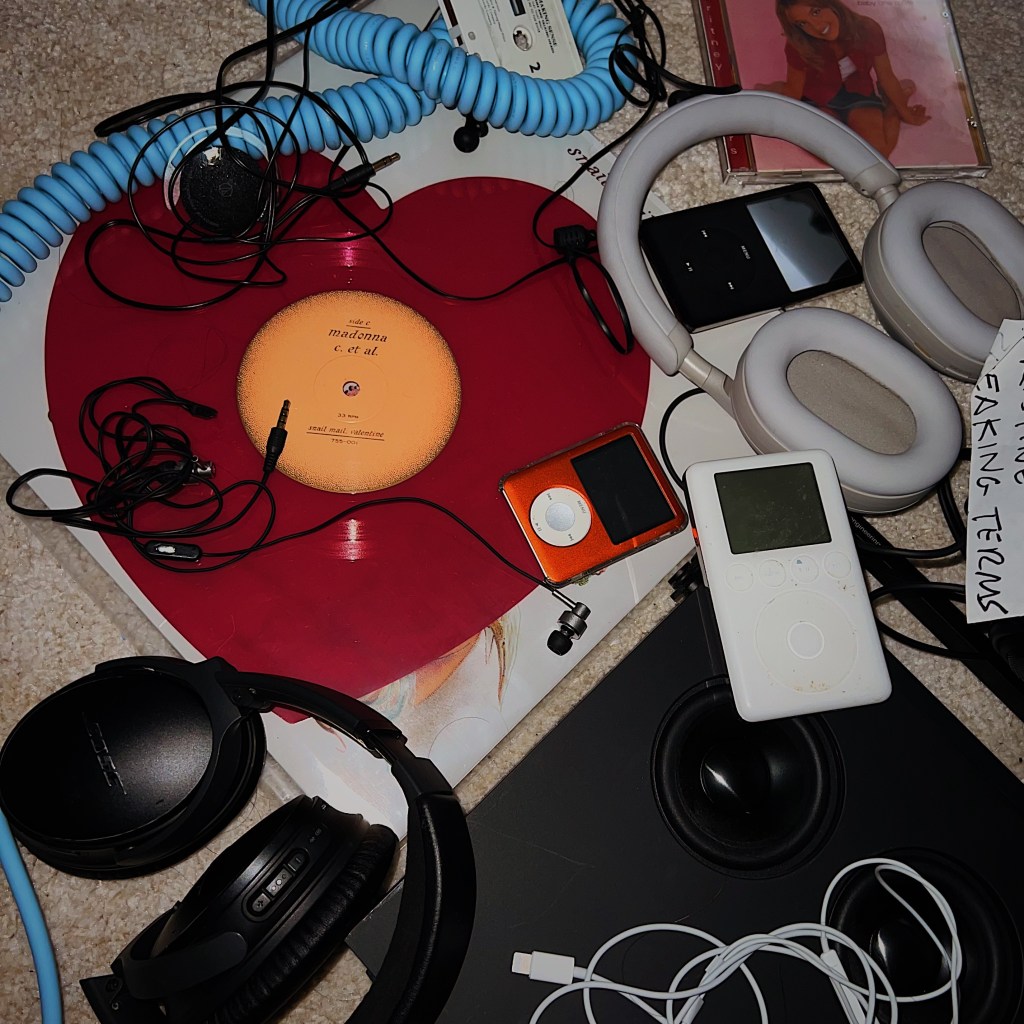
My first brush with high-fidelity sound was a pair of wired Beats earbuds, pre-Apple acquisition. To a middle-schooler accustomed to burnt laptop speakers and felt condom earbuds, a pair of Beats were a heavenly upgrade both in sound quality and clout, despite their overpriced and underperforming nature. On the frontier of audiophile bliss, I explored the tinny depths that my first generation urBeats could reach with my Windows Phone. I frolicked through the lush soundscapes that my sixth grade playlists cultivated – Cake’s The Distance never sounded so good. Musical serenity, all interrupted when the cable snagged on a Car Seat Armrest and severed the femoral artery of my right earbud.
After the accident, audio only played through the left channel unless I pinched the base of the wire at a certain angle. Without that careful maneuvering, not-so-subtle shocks were sent down my ear canal – not exactly what I had in mind when cranking Electric Feel.
Since then, I’ve spent a decent sum of money and effort chasing good sound, and today it couldn’t be any easier. Grab yourself a Tidal subscription and you’re off to Lossless Lane, or invest in some passives and a turntable and cruise Vinyl Boulevard. Nearly every headphone on the market offers noise cancellation – simply block out all the distractions for your private listening experience. Good sound has never been more accessible.
But what is “good” sound? An audiophile would point to whatever format and environment can produce the cleanest output of the most accurate source – achieving the same level of detail as the master recording made in the studio. That’s certainly enticing, to hear exactly what the artist intended to produce. Yet that framework only works for recorded sound, and even then there are issues. Look to the lo-fi beats and bedroom pop scenes that grew in the 2010s, all produced without the power of traditional studios (“hehe did you know Steve Lacy made Dark Red on an iPho-” YES, I DID! SHUT UP!).
If there is “good” sound, then what is “bad” sound? My busted Beats were certainly bad. Even when in working order, the low-ends were much too loud – bass boosted Green Day sounds as bad as it sounds. The setting must be considered too – in the car, in the club, in the mosh pit, are those listens “bad” with all the extra noise around you?
No. The noise makes music better.
An off-key call and response. A waterlogged speaker. A rolled down window. A walk. A scratched CD. A bathroom at the party. A crowded dance floor. A rainy day. A study session. A videogame menu. A thin wall. A skipping record. A dead earbud.
I knew that every time the Beats shocked my ear I was listening to a song in a way that nobody else ever had and ever will. That sound was mine, that music was mine. I know which songs skip on my copy of The Stranger. I know how Pusha T shakes my car’s speakers against my knee. I know what Diplomat’s Son sounds like on vinyl vs CD vs my Bose vs my Sony vs my Sennheiser vs my iPhone in the shower (all very different). Every time I hear a song at a concert, or through a window leaking into the street, or in a sea of dancing bodies, I know that I’ll never hear it in such a way ever again. That dynamic quality of music is what makes listening to it special – the way you listen is what creates the deliberate, personal, and impactful experience, not what you listen to.
It’s easy to settle into a listening routine once you’ve made your playlists and bought your ANC headphones, so it’s important to consciously break it. Pop on the old headset you recently upgraded, shuffle through in-ears and on-ears and over-ears, sit outside with a speaker for lunch, buy your favorite album on cassette and digital and vinyl, disconnect the bluetooth and switch to FM, see every artist you like and see some artists you don’t. Listen. Listen. Don’t wait.
 gone gazing
2 responses to “sometimes, music should sound bad”
[…] leaves us to fill in our own interpretations between the notes. What we listen to, where when and how we listen all add meaning, and that’s why we listen. So, don’t just Skew It on the Background-B list […]
LikeLike
[…] Jockstrap, Magdalena Bay, and dozens more. “Rill Rill” went triple platinum in my broken earbuds for […]
LikeLike