
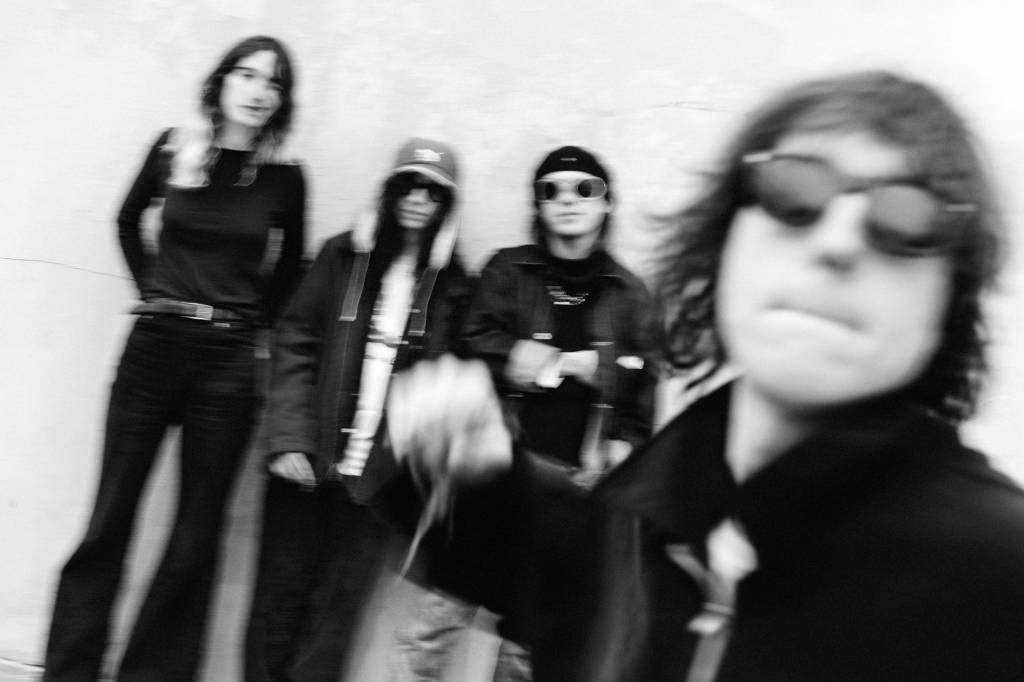
Geese marched off the 9:30 Club stage following a vivacious breakdown of their lead single “Taxes” to close out their DC set on the Getting Killed tour. As the stage went dark, three lights burned above the audience, illuminating the crowd just enough to question if the show really was over. A few wanton heads streamed out of the over-packed pit as chants of, “GEESE GEESE GEESE,” and , “ONE MORE SONG,” wrung out from the chorus of Cameron Winter impersonators.
Yet the lights remained steady. There was no staff replacing instruments for the next songs, no flashlights twirling backstage, no view of the band peeking around the curtains. Just three lights casting a warm hue. The show was over. But after what felt like an eternity, and when many had accepted that they may not be coming back, those lights went dark, a small light directed the returning band on stage, and Geese ripped into “4D Country” and “Trinidad” to close the night out for good.
Live music has been a bludgeoning source for online discourse in the last few years, as the effects of COVID, economically and socially, continue to reverberate through concert halls across the United States. From touring costs and ticker prices to “concert etiquette” and barricade queuing, there’s always something new to complain about whenever someone steps outside to see a gig.
One such topic is the encore. The practice of concluding a set, walking off stage, and being summoned back by a roaring audience to continue playing was once a genuine occurrence – an act moved so much by the thunderous applause that they return to the stage to give the crowds a little more. In the past few decades, though, that once spontaneous tradition has become the norm, to the point it is usually built into the set itself. Now that it is the expectation, complaints about the practice seem valid at first. Why waste everyone’s time by burning a minute to walk off the stage when everyone knows the band’s coming back? Why pretend to end the show early when everyone knows they haven’t played their most popular song? When you’ve seen the same script played out across every gig you attend, the novelty gets old.
I’d argue, however, that encore is still a critical piece of the live music template, and is the make-or-break part of the night that determines if a crowd will leave exuberant or hungry for more. Moreover, that any pre-planned encore falling flat is a symptom of an artist’s poorly designed set rather than a flaw in the practice. To do so, I’ll breakdown why the encore is still essential, then share what makes an encore great, and finally try to dissect where the frustration with the practice is coming from in today’s live music economy.
Why We Need Encores
The encore serves an essential function for both artist and audience each night. For the band, it is a well-needed break. They’ve been playing for at least an hour, sneaking in sips of water in between quick changeovers, and probably just finished performing their biggest hit song as the climax of their set. To land the plane and send everyone home happy, the walk off stage is a brief chance to catch their breath and get ready to go all out with the closing tracks.
The encore also provides an opportunity to experiment with a set’s energy and thematic direction, especially for acts that are touring with multiple albums or projects under their name. The main segment of the set should be formed around the latest songs that the tour is supporting, but that may not allow room for deep cuts or fan favorites from older records to find a place. The encore is there to supplement that, and to allow older songs to flourish where they may have felt out of place amidst the primary set and its sonic and thematic direction.
A recent example of this is Magdalena Bay’s Imaginal Mystery Tour. The set at its shortest includes a full run-through of Imaginal Disk as the main set with an encore of “The Beginning” to close out. Longer shows allowed the band to mix in songs like “Kill Shot” and “Tonguetwister” and the occasional David Bowie cover. The primary set being the entirety of Imaginal Disk thus worked to show the album’s conceptual plot on stage while sprinkling in older songs when time allowed. The encore then exists as a separate act of their production, letting their crowd-pleasing closer from Mercurial World end the night on a high note.
While its important to manage the energy on stage, its equally important to do the same in the audience. With the climax of the show at the last song in the main set, the crowd needs a break as well, and it lets folks move in and out of the crowd for water, a new view, or to leave the show early to try and beat the traffic (they won’t). It does two important things; one, the real ones have a chance to get closer and pack in for the encore and two, it provides the only opportunity for a guaranteed community moment of the night.
As soon as the band steps off stage and the lights first dim, the first chant that develops out of the closing applause is always, “ONE MORE SONG.” No audience has ever sang in tune, no audience has ever clapped on the right beats, no audience has ever sang back to the frontman with the right part of the bridge. Chanting “ONE MORE SONG” is the one thing that nobody in the room can mess up. And its magical.
Imagine someone at their first show, hearing their favorite songs and seeing their idols in the flesh. When the band leaves the stage, there’s no expectation of any more. But then, everyone in the room starts chanting in unison, and they then join in, and miraculously the band comes back out and plays a few more. Was that a rehearsed part of the set? Yeah, probably. But the kids don’t know that. And they’ll leave thinking the crowd really was the band’s favorite of the tour and that the encore was special just for them. And it’ll be magic.
There’s also a non-zero chance you actually get a real encore if you clap loud enough. I saw Julie at Songbyrd on Halloween 2023, and they had no more songs left in their discography so they just did a Nirvana cover after the crowd brought them back on stage. I saw Kate Bollinger at a UVA garage show when she had maybe four songs out, and the encore was some unreleased songs performed on acoustic without her band. There’s also nothing stopping artists from just replaying their biggest song – 2hollis routinely ends his concerts with three to eight renditions of “Jeans.”
What Makes a Good Encore
So we’re in agreement that the encore is essential, but admittedly, many of them do feel pretty flat. There are three elements that I see as essential for making the encore the defining moment of the night.
First, the set needs to end in a way that would be satisfying without the encore. The Magdalena Bay tour fits this bill, as the main set concludes with the epic “The Ballad of Matt & Mica” that closes their latest record. The track is on theme, wraps all of the plot points of the concept album, and is a perfect sing-a-long to close. It would be totally acceptable to call it right there and go home, but they level it up one last time with the encore for the real finale.
Another example is Vampire Weekend’s Only God Was Above Us tour. The show opens as the band comes on stage as a faux three-piece with original members Ezra Koenig, Chris Baio, and Chris Thompson playing hits and b-sides from their self-titled album in front of a curtain obscuring most of the stage. After three songs, they play the opening track of their latest album “Ice Cream Piano” and drop the curtain to reveal the full band and explore their re-imagined discography through the rest of the set. There are rotating set pieces, like the different jam band portions in “Sunflower,” “Sympathy / NEW DORP NEW YORK,” and the “Cocaine Cowboys” mash-up. Finally, the set closes with “Hope” – the ending track of OGWAU. After the main show concludes, they have a request zone where they try to improvise covers of anything but Vampire Weekend songs, then finally close with their encore tracks “Worship You” / “Ya Hey” or the classic “Walcott.”
This set weaves through their entire discography, creative changes with their sound, and the personal history of the band to create a cohesive plot on stage. Its interactive and dynamic, and having seen the show four times, allows for immense creativity in the setlists and experiences night to night. Without the request zone and encore, “Hope” is still a perfect conclusion to the night, and I would feel satisfied if it ended right there.
But the important part of “The Ballad of Matt & Mica” and “Hope” within the context of their entire sets is that both songs leave just enough tension hanging in the air – maybe, just maybe, there’s more to come. And perhaps the most critical part of a good encore is that tension, that itch for one more song, and how a band stokes and exploits it.
The best encore I’ve seen in the last two years was at the Geese show I described at the start of this post. It was the longest wait from the set ending and the encore beginning that I have felt in a long time. The air was dense and buzzing, and most of the crowd was paralyzed. Of course, the show could have just ended with “Taxes” and it would’ve been great. But it didn’t. They let the encore simmer until it was ready to boil over, and only when the crowd was ready, they came back to the stage and tore the house down, Cameron Winter screeching at the end of the encore, “fuck these people who live here,” an apt message for all the devils, red and blue, that reside in the District of Columbia.
Time, then, is the second element of a good encore. Too many bands walk off the stage and come back within the same minute, and that’s why so many encores just look like stage antics that waste time and take away space for another song or two. You have it let it simmer. And when combined with that anxiety of feeling the show might really be over, the wait time amps up everything about the encore, and transcends the atmosphere for the rest of the night.
Finally, and perhaps most obviously, the encore needs to have the right songs. If the band hasn’t played their hit song with 10 times more streams than the rest of their catalog combined when the main show ends, just guess what’s coming in the encore. It’s too predictable. Thus the ideal encore is a fan favorite deep(ish) cut or the band’s best closing song. Geese fits that bill with “4D Country” and “Trinidad.” Magdalena Bay fits with “The Beginning.” Vampire Weekend fits with “Walcott.” These are not their most popular or best songs per se, but they are the best for their role of closing the night.
But, of course, there is the exception that proves the rule. The best two encores of my life came in 2023 with The Cure at Merriweather Post Pavilion. They first played an hour and a half of gorgeous gothic rock and shoegaze, and I couldn’t pick apart one song from another as they pushed walls of sound back out to the lawn where I sat with the worst view ever. When they left the stage before the first encore, I thought, “that was incredible.” Then they came back on with new energy and blazed through five songs that ended with the dreamy “Disintegration,” and I thought, “that was absolutely amazing.” Then they came out for the second encore, and every song was like getting run over by a semi-truck.
“Lullaby” to “Fascination Street” to “The Walk” to “Friday I’m in Love” to “Close to Me” to “Why Can’t I be You?” to “In Between Days” to “Just Like Heaven” to “Boy’s Don’t Cry.” I had never heard anything like it, and probably never will again. There are very few bands in history that could put up an encore like that, but for those that can, it would be extraordinary to run through some of the biggest pop hits of all time within a fifteen minute block to close out a show.
Why This Matters
Most of the encores I do see are just fine, and at worst just feel like a part of the set that gets cut off by a wasteful walk off stage. In the last few years, though, I’ve started to see more and more artists omit the encore, likely due to that sentiment. But for as long as we have known the encore, it is now the expectation, and when that tradition isn’t honored, it just feels wrong. That tension that builds after the final song of the set has no release. The lights come on and the “go home” music starts playing before we’ve had a moment to catch our breath. We’re just edged to nowhere essentially. The encore should always be the true finale, and there are very few instances where going without it feels right.
As these live music traditions erode, what’s next? We’ve already lost ticket stubs and physical maps to festival grounds. Warm lighters replaced with cold LED flashlights. VIP sections eat up general admission space as prices across the board skyrocket. Dancing is dead. Should artists stop printing setlists out to give to a lucky few at barricade? Should we just get rid of the opener?
We’re losing so much of what makes live music magical and replacing it with stress and higher costs. When there’s such an intense pressure to stuff in as much music in the set as possible and eliminate the “waste” that makes concerts magical, everyone misses out. The never ending push for efficiency steals away the messiness, the slowness, the patience, and the release that makes a great concert and a great encore.
At the end of the day, it’s also just fun to be in on the joke. The band knows the encore is fake, the crowd knows the encore is fake, the sound guy trying to pack up early knows the encore is fake. Just clap along. Yell, “ONE MORE SONG.” Its your night out, after all. Have fun!
 gone gazing