
From the glass windowed shop up ahead, Bob Dylan is throwing his troubles out the door, which is propped open wide to the street with a plastic crate of free records. Inside, the needle whispers over dead wax, the record is swapped, and Bob returns for a brief encore with George Harrison’s “I’d Have You Anytime.” The dust, not quite settled in for the day, gives the record store a glittering appearance.
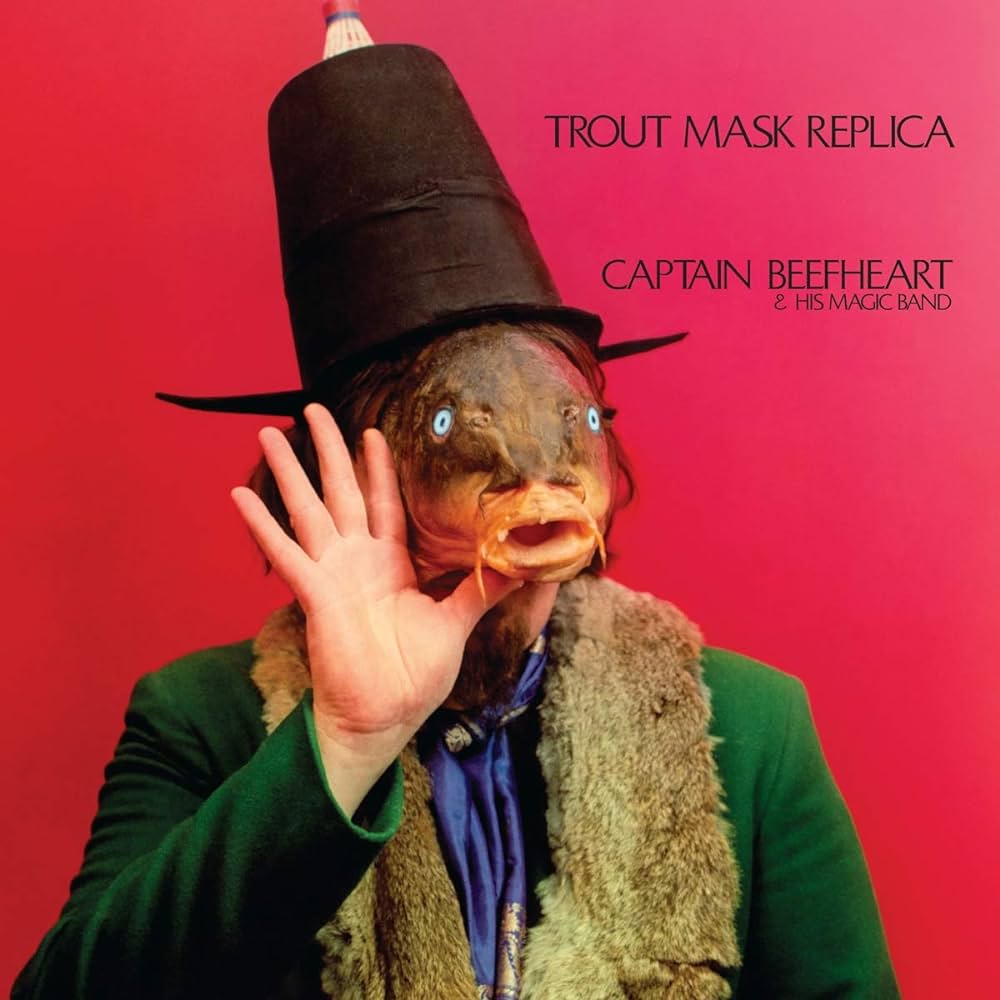
High up on a wall behind the counter, a man with a fish for a face stares down at customers from his dowel perch. Day in and out, people step through the propped door to flit across sleeves of cardboard, from wooden crate to crate, while the face on the wall watches their progress with a timeless vigilance. Against a crimson background and sporting a tall black hat and fur collar, the fishman warbles silently behind a frozen palm-out gesture of operatic dramaticism. What could those drowned eyes have seen to gaze so unnervingly? What voice does this aquatic troubadour intone? “Trout Mask Replica by Captain Beefheart and His Magic Band,” reads the cover in dark Basilea typeface. What does it all mean???
Firstly, what is it? Trout Mask Replica began as a passion project for multi-artist Don Van Vliet, otherwise known as Captain Beefheart. In 1968, signed to Frank Zappa’s label and cushioned with a successful debut release, Van Vliet set out to write the twenty-eight tracks that would eventually become Trout Mask Replica. At the time, His Magic Band comprised of a motley assortment of thoroughly talented musicians, many of whom would sail on in their Captain’s good faith for the remainder of his musical career.
They rehearsed and worked extensively with their Captain for over a year, translating writing that was sometimes no more than mere impulses to each instrument. This proved more difficult than assumed, as Van Vliet wrote each song on an upright, seven-and-a-half octave piano (a standard number of octaves for pianos) without knowing quite how said instrument worked, and fully believing the abilities of his magical band sufficient to bridge the musical language barriers between. Ultimately, they were successful and with production credits by Zappa, Trout Mask Replica was released as a double record in 1969.
And the result was… really weird. Gruff babble, wailing dissonance and a general aversion to synchronous rhythm makes this infamous record, at once, off-putting and infectious. From no direction is Trout Mask Replica approachable, and yet we endeavor to do just that!
Still held in high regard by artists and music snobs and mentioned alongside some of the greatest records of all time by chronic list-making Radiohead stans, TMR seems to carry an attracting quality that built the puzzling fame of this sporadically inaccessible classic. Nearing its 55-year anniversary we thought to celebrate its wacky lineage with our impressions of each flip of the record. Listened in the free, full-length, ad-laden YouTube quality you’ve come to know and trust!
Side A
The first side gives listeners a comprehensive sample of all that is to be expected from Trout Mask Replica, even if it fails to prepare the unprepared for exactly what they will hear. Stylistically it is experimental and draws from blues, jazz, “rock”, (see: Is Trout Mask Replica grindcore?) and invites classification from all the rest. Lyrically, it befits to call the record… poetic.
“Frownland” is possibly the only song on TMR that works as an opening track. It feels somewhat set apart from the rest of the album, like a single released months ahead of a new album, while still being the finest invitation to the rest of the experience.
Everyone is playing in a different time signature and there are no standards for consistent rhythm. That alone, playing so “off” that it is innately obvious, is not only technically impressive but also maddening with how intentional it sounds the closer you listen. Now, take my hand and fly from Frownland!
The first skit, “The Dust Blows Forward ‘N The Dust Blows Back” kicks poetry night off in a Zappa-esque, oddball humor sort of way. By now, the musicians have wrangled in the rhythm on “Ella Guru,” after rehashing Bob Dylan’s 103rd dream on “Dachau Blues”, talking WWIII blues (again). Then, startlingly, some very disgruntled woodwinds take flight in “Hair Pie: Bake 1” on their way to the airport, and they misgauge their departure terminal and wind up way down in the land of muddy blues on “Moonlight on Vermont.”
Urgent would be an apt descriptor of the record’s first quarter; or as Captain Beefheart himself put so eloquently: “fast and bulbous.”
Side B
There are several moments, even from the first six songs, where turning the record off and never giving it a second thought would be an entirely appropriate response. With a mere turn of phrase, tracks “Pachuco” and “Neon Meate Dream of a Octafish” have been known to activate some listener’s fight or flight.
“Fack ‘n feast ‘n tubes tubs bulbs / dank drum ‘n dung dust / mucus mules / cavorts girdled ‘n latters uh lite / squirmin’ serum ‘n semen ‘n syrup / neon meate dream of a octafish.” I mean sure.
After “Frownland,” side B is home to some of the showier instrumentals on the record and some cautiously delightful moments. “Bills Corpse’s” bass is ripe and bloated with the stench of death, while the lines in “Sweet Sweet Bulbs” are plodding and pregnant with the bloom of new life. There are intrusive outbursts of cacophony and negativity throughout both tracks, but they are rather exciting and help build towards our understanding of the verb “bulbous.”
“China Pig” is the most obvious example of the record’s blues influence and sounds a lot like their guitarist was recording indoors with Don Van Vliet outside yelling the lyrical poem through a screen door. “My Human Gets Me Blues” sounds ironically more like a free jazz breakdown than blues and “Dali’s Car” is another entropic spectacle inspired by the ephemeral Salvador Dalí sculpture, Rainy Taxi.
Marshalling the courage through the very weird parts of side B is worth it alone just to hear all the bulbous bulbs doing their bulb thing in Spring. And they’re certainly bulbin’.
Side C
Well, well. Here we are. What to say, what to say. In short:
Do not ask Joan about her hands.
“Fallin’ Ditch” was written for Tom Waits.
“Sugar ‘N Spikes” is sweet and sharp, not fast and bulbous!
God, I hate the term “avante garde.”
Please ants, just leave me bee!!
Side D
There is still much to be deciphered within Captain Beefheart’s poetry, hiding in the nooks and crannies and sharp elbows of his stories. For one last turn of wax, the Captain returns to stage for encore poetry hour on “Old Fart At Play” and “Orange Claw Hammer,” the latter a surly tale inspired by the real life of a Philadelphian dentist, nicknamed “Painless Parker,” who is remembered for saving thousands of his patients’ pulled teeth in a wooden bucket.
The confounding eccentrics of Captain Beefheart’s storytelling maybe recall those of The Hatter, the maddest of all characters in Lewis Caroll’s novel Alice’s Adventures in Wonderland. Van Vliet’s caricature is manic in his deliveries of prose and delirious in his tirade of quick-pickled, half-riddled nonsense. “That’s the raspberries”… if only he puzzled out why a raven is like a writing-desk.
He brings tales of a man’s retreat from his “Wild Life” to reside atop mountains; high up where gales tug angry air through the woodwind, up the footslope, to rest upon his summit abode. He also namedrops Lil Uzi a few times on “She’s Too Much For My Mirror,” and pioneered texting shorthand well b4 u on the beautiful “Steal Softly Thru Snow”. “The Blimp” and “Hobo Chang Ba” fill out with gurgley tracks and “Veterans Day Poppy” brings the final moments of Trout Mask Replica to a close with one last boogaloo, that ends up being more of a melancholy runamock than your standard, run of the mill boogaloo. Perhaps they were remiss to close the book on the record.
The little assurances of Trout Mask Replica’s ridiculousness, even from some of the band members themselves, add a final layer of enjoyment to the record. Live reactions of Van Vliet feeding lyrics to His Magic Band were included in some of the skits and break up the unrecognizable with quick smiles. It is challenging and fun to listen to, as likely it was to record.
Liner Notes
Now, why does it matter? Trout Mask Replica is this great respected work that questioned musical conventions, pop tropes and fundamental rules in music theory. It cast its influence with a wider net and brought music experimentation to a world of baffled listeners. You will find no scarcity of analyses in the fathomless depths of the internet, leastways here. And yet, it may not be that deep.
Yes, there is a vastness and depth to Van Vliet’s disjunct poetry and the caliber of musicianship on the record is more than worthy, but most of Trout Mask Replica’s disarming aspects come from its voice. The trout sounds whimsical and outlandish (and of course, fast and bulbous). There is something inherently attractive in art that doesn’t take itself too seriously.
Don Van Vliet did not set out to create a masterpiece but did achieve artistic mastery over his vision in a curious, near innocent, labor of love. Enabled by total creative freedom, Captain Beefheart was able to refine his imaginative motifs into expressions of emotive creativity, in an unhinged sort of way, and through exhaustive rehearsal sessions, managed to get a truly unique performance from every member of His Magic Band. It is out of a zealous approach to songwriting and endearing naivete that one of the most confusingly original works of art in history grew.
Whether or not you need to listen is up to you, but know that, for better or worse, Trout Mask Replica will always be there. Somewhere, high up on a wall, watching the dust settle in the glinting sun.
 gone gazing